

As the Q3 earnings season comes to a close, it’s time to take stock of this quarter’s best and worst performers in the home construction materials industry, including Gibraltar (NASDAQ:ROCK) and its peers.
Traditionally, home construction materials companies have built economic moats with expertise in specialized areas, brand recognition, and strong relationships with contractors. More recently, advances to address labor availability and job site productivity have spurred innovation that is driving incremental demand. However, these companies are at the whim of residential construction volumes, which tend to be cyclical and can be impacted heavily by economic factors such as interest rates. Additionally, the costs of raw materials can be driven by a myriad of worldwide factors and greatly influence the profitability of home construction materials companies.
The 11 home construction materials stocks we track reported a slower Q3. As a group, revenues were in line with analysts’ consensus estimates while next quarter’s revenue guidance was 0.6% below.
Amidst this news, share prices of the companies have had a rough stretch. On average, they are down 10.1% since the latest earnings results.
Gibraltar (NASDAQ:ROCK)
Gibraltar (NASDAQ:ROCK) makes renewable energy, agriculture technology and infrastructure products. Its mission statement is to make everyday living more sustainable.
Gibraltar reported revenues of $310.9 million, up 12.2% year on year. This print fell short of analysts’ expectations by 2.1%. Overall, it was a softer quarter for the company with a significant miss of analysts’ revenue and EBITDA estimates.
“Our third quarter results reflect our focus on execution in a dynamic business environment, particularly in residential roofing, where our building accessories business posted 2% growth in a market that was down 5% - 10% depending on the channel. In our Agtech business, a large controlled environment agriculture (CEA) project was delayed as expected and impacted revenue in the quarter. On adjusted net sales growth of 13%, adjusted EPS came in slightly below prior year, impacted by both business and product mix. Backlog increased 50% in the quarter and operating cash flow grew 39% to $57 million,” stated Chairman and CEO Bill Bosway.
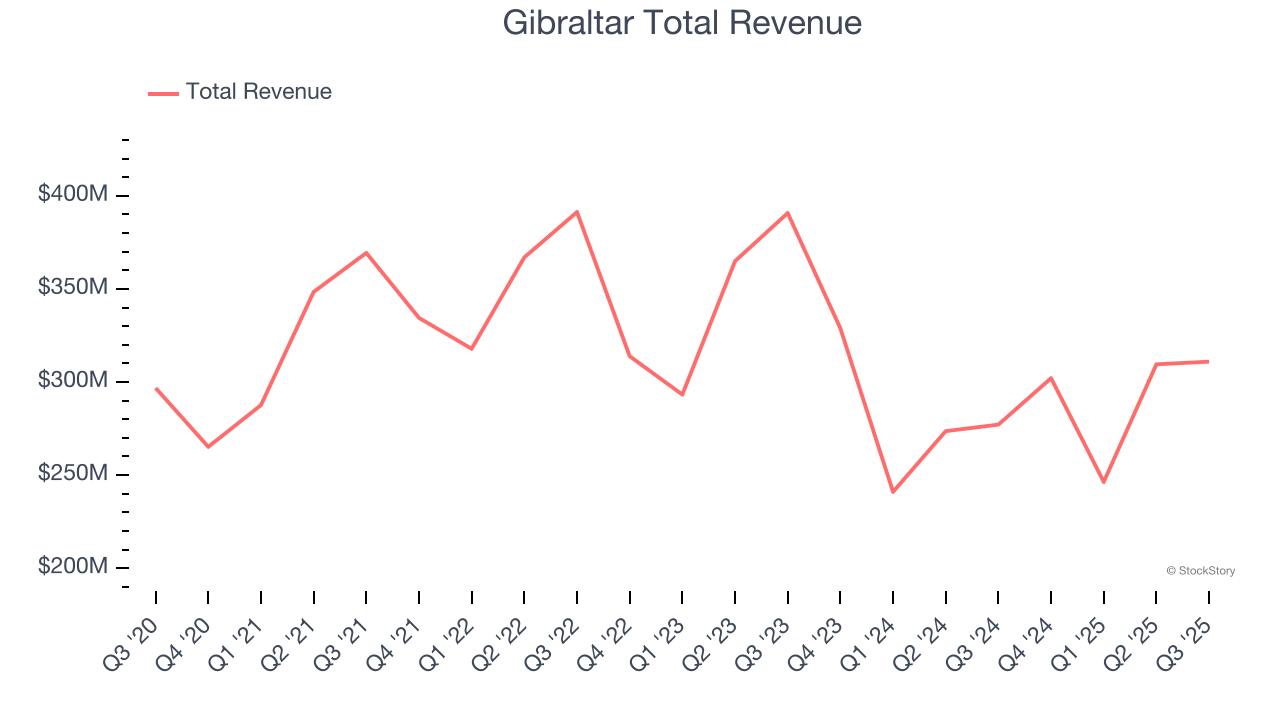
Unsurprisingly, the stock is down 27.5% since reporting and currently trades at $48.64.
Read our full report on Gibraltar here, it’s free for active Edge members.
Best Q3: Hayward (NYSE:HAYW)
Credited with introducing the first variable-speed pool pump, Hayward (NYSE:HAYW) makes residential and commercial pool equipment and accessories.
Hayward reported revenues of $244.3 million, up 7.4% year on year, outperforming analysts’ expectations by 5.5%. The business had a stunning quarter with an impressive beat of analysts’ organic revenue estimates and a solid beat of analysts’ EBITDA estimates.
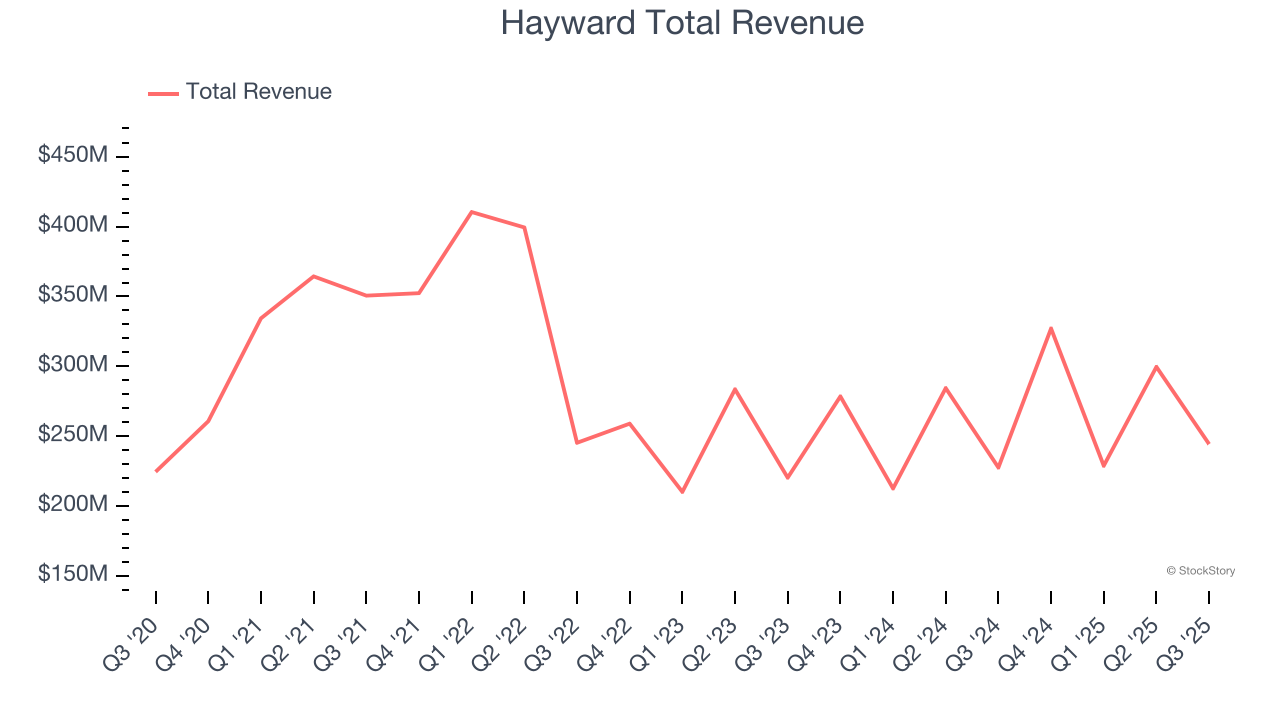
Hayward pulled off the biggest analyst estimates beat and highest full-year guidance raise among its peers. The market seems content with the results as the stock is up 2% since reporting. It currently trades at $15.66.
Is now the time to buy Hayward? Access our full analysis of the earnings results here, it’s free for active Edge members.
Slowest Q3: American Woodmark (NASDAQ:AMWD)
Starting as a small millwork shop, American Woodmark (NASDAQ:AMWD) is a cabinet manufacturing company that helps customers from inspiration to installation.
American Woodmark reported revenues of $394.6 million, down 12.8% year on year, falling short of analysts’ expectations by 2.4%. It was a disappointing quarter as it posted a significant miss of analysts’ revenue estimates and a significant miss of analysts’ adjusted operating income estimates.
Interestingly, the stock is up 4.3% since the results and currently trades at $54.10.
Read our full analysis of American Woodmark’s results here.
Simpson (NYSE:SSD)
Aiming to build safer and stronger buildings, Simpson (NYSE:SSD) designs and manufactures structural connectors, anchors, and other construction products.
Simpson reported revenues of $623.5 million, up 6.2% year on year. This print surpassed analysts’ expectations by 3.1%. More broadly, it was a slower quarter as it recorded a significant miss of analysts’ EPS estimates and a miss of analysts’ EBITDA estimates.
The stock is down 6.3% since reporting and currently trades at $164.71.
Read our full, actionable report on Simpson here, it’s free for active Edge members.
Trex (NYSE:TREX)
Addressing the demand for aesthetically-pleasing and unique outdoor living spaces, Trex Company (NYSE:TREX) makes wood-alternative decking, railing, and patio furniture.
Trex reported revenues of $285.3 million, up 22.1% year on year. This result missed analysts’ expectations by 5.3%. Overall, it was a softer quarter as it also recorded full-year revenue guidance missing analysts’ expectations significantly and revenue guidance for next quarter missing analysts’ expectations significantly.
Trex achieved the fastest revenue growth but had the weakest performance against analyst estimates among its peers. The stock is down 26.4% since reporting and currently trades at $34.10.
Read our full, actionable report on Trex here, it’s free for active Edge members.
Market Update
The Fed’s interest rate hikes throughout 2022 and 2023 have successfully cooled post-pandemic inflation, bringing it closer to the 2% target. Inflationary pressures have eased without tipping the economy into a recession, suggesting a soft landing. This stability, paired with recent rate cuts (0.5% in September 2024 and 0.25% in November 2024), fueled a strong year for the stock market in 2024. The markets surged further after Donald Trump’s presidential victory in November, with major indices reaching record highs in the days following the election. Still, questions remain about the direction of economic policy, as potential tariffs and corporate tax changes add uncertainty for 2025.
Want to invest in winners with rock-solid fundamentals? Check out our Top 6 Stocks and add them to your watchlist. These companies are poised for growth regardless of the political or macroeconomic climate.
StockStory’s analyst team — all seasoned professional investors — uses quantitative analysis and automation to deliver market-beating insights faster and with higher quality.